 Visits to the end-of-life Centres
Visit to Athanasios
Visits to the end-of-life Centres
Visit to Athanasios
“they have come all this way, they have paid all this money, how can they be sure this is for real and not just a myth ?”
Athanasios was launched in the middle of March 2025. When I visited them in Basel five weeks later, they had completed their first eighteen applications for Voluntary Assisted Deaths (VADs). By the end of 2025 they had completed 82. This is an impressive start.
However, the team already had a great deal of experience. Carlos Cabrera had been a senior nurse at Pegasos – it was his job to insert the cannula into a patient’s arm and to ensure that all equipment was working properly. Sylviane Geist had also worked for Pegasos and before that had helped Erika Preisig at Lifecircle. They work with two medical doctors and three psychiatrists, all of whom have also worked either for Pegasos or Lifecircle. The evaluation of each application involves six staff members altogether, starting with an individual “personal advisor”.
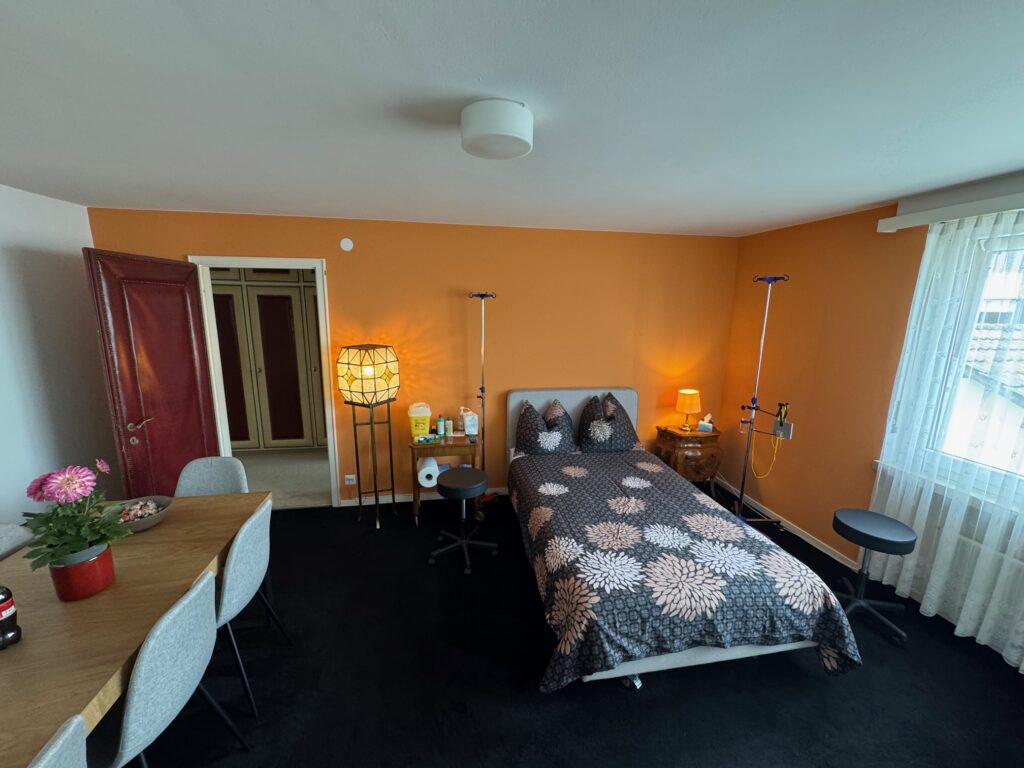
Athanasios operates from a house in Allschwil, a suburb of Basel about four miles west of the city centre. It is also four miles from Basel Mulhouse airport. The Allschwil house is both their office and the location of their VAD apartment. It does not possess the rural scenery of Pegasos’s Roderis property but is not so “industrial” as the two apartments in Liestal. Internally, it resembles the Blue House used by Dignitas near Zurich, though it is more urban and not so large.
Like the others, they use Nembutal (pentobarbital of sodium) as their medication. They also use the cannula method of application, thus giving them a basically different methodology to Dignitas – where the patient is usually asked to drink it.
Their basic philosophy is expressed as
“We are convinced that self-determination is a fundamental human right, especially during life’s most difficult moments.”
In their application of this approach, however, they are much nearer to Lifecircle than to Pegasos. Whilst Pegasos has often been reported, probably wrongly, as almost offering suicide on demand, Athanasios take definite steps to ensure that the reasons for the patient’s choice do make absolute sense from the patient’s own viewpoint.
They do not expect a patient to be terminally ill. Age is relevant, however. A patient in their late seventies or eighties might be accepted on the basis of several “co-morbidities”, none of which are individually fatal. A younger person in their thirties would find it much more difficult to qualify. Similarly, an individual in their forties or fifties experiencing a divorce or acute bereavement might also have an uphill battle to persuade Athanasios that their life was unlikely to improve, unless they were quite ill and had a diagnosis to demonstrate that.
It was Carlos, then at Pegasos, who attended to the VAD of psychologist Daniel Kahneman, the winner of the Nobel Prize for economics in 2002. Dr Kahneman was 90 at the time of his death in 2024 and was not terminally ill. His farewell letter, a masterpiece of its kind, forms part of this website as Appendix Three.
The application process is very straightforward. You do not need to be a member. You simply pay a one-off non-refundable fee of 100 Swiss Francs (£90 or $120) and that covers the evaluation cost of your case. You will then need to submit your application and all its required documentation. If everything is is order you will then be given a green light to proceed. At that stage, your first payment (4,500 Swiss Francs) will need to be made. Athanasios will then arrange a video call with you at which the precise requirements of your own case cane be discussed. Only when a date has been agreed will your second payment (5,000 Swiss Francs) need to be made.
So, how long does the green light last ? Are you expected to go straightaway or can you keep it as a sort of insurance policy ? The answer is that the green light itself never does expire but your documentation and the doctor’s prescription will inevitably become dated. Any VAD must, under Swiss law, be accompanied by current paperwork. In practice, therefore, your VAD date should be be within six months of your application.
Unlike most of the other VAD providers, Athanasios are prepared to accept clients travelling alone.
An approach to Athanasios could well make sense for patients in the UK or USA who have been told that they must find a local psychologist or psychiatrist to support their applications for a VAD. Such people are very hard to find, whatever the strength of the patient’s case. They are often required to certify that the patient still passes the “sound mind” test in spite of a relatively mild neuro-degenerative illness or when suffering from some kinds of depression. Athanasios do not insist that such a mental health consultant must be local to the patient. Instead, they are prepared to ask one of their own psychiatrists to do that job. It will usually, of course, involve a video call during which a very detailed examination must take place. Even without such a video call, Athanasios might, in appropriate circumstances, be prepared to rely upon a personal visit in Switzerland at least one day before the VAD itself.
The Athanasios team were also keen to emphasise that VAD visitors do require close personal reassurance. In the words of Sylviane “They have come all this way, they have paid all this money, how can they be sure this is for real and not just a myth ?”
Their total costs come to CHF 9,500 (£8,600 or $11,900), which includes CHF 2,500 for the application process and CHF 2,500 for the funeral and cremation services (see section 6 of this website)
You are not expected to pay everything up-front. For foreign applicants, an initial payment of CHF 4,500 needs to be paid, with the second of CHF 5,000 paid no later than four weeks before your arrival for the VAD.
With continuous care in mind, as soon as a completed online application form has been received together with the initial CHF 100 fee, a “personal advisor” is appointed to the case. That personal relationship will remain throughout any subsequent process. The advisor will make contact with the applicant to clarify any questions and to discuss their situation in detail.
Capacity
Athanasios is starting with the capacity to handle up to one AVD per day. That would imply around 200 per year in total, or approximately 30% of the estimated total of annual AVD visitors to Switzerland. They are forecast to handle between 80 and 100 cases in 2026 (see Appendix Five). The additional capacity is welcome because both Pegasos and Dignitas are currently very busy and Phoenix Care is a more recent starter.
My overall impression was that the Athanasios people are seeking to provide an inexpensive answer for people who have suddenly had to realise that the end cannot be too far aware and that they had better get something arranged now. This is largely a consequence of the huge increase in US demand since the start of 2025. They will not cut any corners, though. Many people, particularly those with complex or psychiatric cases, are indeed being rejected.
Their overall approach is certainly one of sympathy and care for the patient. Their desire for simplicity and speed of decision is dictated by what the patients themselves want rather than any industrial-style efficiency.
Your choice of hotel is left entirely to you. I stayed at the Hotel Krafft which was bang next door to the Rhine, had an excellent restaurant, helpful staff and a room which gave a whole new meaning to the word “minimalist”. Athanasios do not recommend anywhere but have named the Hotel Im Schlosspark in Binningen (looks good, very Swiss and near to the office), the Essential by Dorint (bank of the Rhine, central, business hotel and apparently more reasonable) and the Grand Hotel Les Trois Rois which looked very expensive but suitable for a special occasion – which yours probably is.
Read Next Section >